How Microfinance Software Helps MFIs Grow: 7 Ways to Scale Lending Operations
Discover how microfinance software helps MFIs manage loans, track collections, reduce manual work, improve reporting and grow their branches.
Running a microfinance business is not just about giving loans. Every day, the team has to manage members, form groups, process loan applications, collect installments, maintain accounts and prepare reports.
When an MFI starts with a small number of members, these tasks may be handled using Excel sheets, registers and manual records. The process can work well in the beginning.
But as the business grows, things become more difficult.
There may be more members to manage, more loans to track, more field officers to coordinate and more branches to handle. Finding the right information can take time. Managers may have to wait for reports, and staff may spend hours updating the same information in different places.
This is where microfinance software can help.
The purpose of microfinance software is simple: it helps an MFI manage its daily work in one organised system, keep better records and make decisions using current information.
Let's look at seven ways it can help a microfinance business grow.
1. Manage More Members Without Increasing Paperwork
Every loan starts with a member. The MFI needs to maintain the member's details, contact information, group, loan history and repayment records.
When information is stored in different registers and Excel files, finding a particular record can take time. The same member's details may also be entered more than once.
Microfinance software keeps member information organised in one place. Staff can search for a member, check their details and view the records they are authorised to access.
For example, when a member applies for another loan, the team can review the available loan history and repayment records without searching through several files.
As the number of members increases, organised records become more important. Staff can spend less time looking for information and more time serving members.
2. Keep Group and Loan Records Organised
Many microfinance institutions work with groups of members. Each group may have its own meeting schedule, loan accounts and repayment activities.
Managing these details manually becomes harder when the number of groups increases.
Microfinance software can connect member records with their respective groups and loans. Staff can check which members belong to a group, which loans are active and what installments are due.
Loan details can also be maintained in a consistent format, including the loan amount, repayment schedule, interest details, disbursement date and outstanding balance.
This makes it easier for the office team and field officers to work with the same information.
A manager can also review group-level records instead of collecting information from several separate sheets.
3. Track Installments and Improve Collection Follow-Up
Collection is one of the most important activities in a microfinance business.
If installments are not tracked properly, field officers may miss follow-ups, overdue accounts may remain unnoticed, and managers may not get a clear picture of collection performance.
Microfinance software can maintain repayment schedules and show which installments are due, which have been collected and which remain unpaid.
Field officers can use the available records to plan their daily collection work. Office staff can check collection entries, while managers can review overdue installments and outstanding balances.
Consider a simple example.
A branch has hundreds of active loans. The branch manager wants to know which installments are due today and which members have overdue payments.
Without an organised system, the manager may have to collect updates from different employees or files. With suitable software, this information can be reviewed through reports and loan records.
The software does not guarantee that every installment will be collected on time. However, it helps the team identify pending work and follow up in a more organised way.
4. Reduce Manual Work and Repeated Data Entry
In many MFIs, the same information is entered into multiple Excel sheets, collection registers and accounting records.
This creates extra work. It can also lead to differences between reports when an entry is updated in one place but not another.
A well-designed microfinance system connects related activities.
For example, when a collection is recorded, the system can update the relevant loan's repayment record and outstanding balance according to the configured rules. Where accounting is integrated, the corresponding financial entries can also be handled through the appropriate process.
Staff should not have to calculate every balance manually or prepare every report from scratch.
Automation also helps reduce avoidable data-entry mistakes. Important financial entries should still have proper validation, permissions and review procedures.
The real benefit is not simply having fewer spreadsheets. It is having a clearer process in which information does not need to be repeatedly entered and checked.
5. Understand Business Performance Through Reports
An MFI may be collecting money every day and issuing new loans, but the owner or manager still needs to understand how the business is performing.
How much has been disbursed? How much has been collected? Which loans have outstanding balances? Which branches need attention? How much money is overdue?
If preparing these reports takes several hours or days, management decisions may be delayed.
Microfinance software can bring together loan, collection and accounting information to prepare useful reports.
Depending on the system, managers may be able to review:
- Total active loans and outstanding loan balances.
- Installments due and amounts collected.
- Overdue installments and repayment performance.
- Loan disbursement and collection activity by branch.
- Field officer activity and collection records.
- Income, expenses and other accounting information.
These reports help managers see where attention is needed.
For example, if one branch has more overdue installments than usual, management can investigate the reasons and plan the required follow-up.
Reports do not replace good management. They help managers make decisions based on recorded information rather than relying only on verbal updates.
6. Expand to More Branches With Consistent Processes
Opening a new branch is a major step for a growing MFI. But expansion also creates new responsibilities.
The organisation must maintain consistent loan procedures, collection records, accounting practices and reporting across branches.
Without a common system, each branch may develop its own spreadsheets and working methods. Comparing performance becomes difficult, and the head office may struggle to get timely information.
Microfinance software can provide a common working process for all branches.
Depending on the system's capabilities, authorised users can manage branch-level records while the head office reviews overall performance. Roles and permissions can control who can view, enter, approve or release particular transactions.
This is especially useful when the business has several branches and different employees handling member registration, loan processing, collections and accounting.
A growing MFI needs more than software that works for one office. It needs a system that can support additional branches without creating unnecessary confusion.
7. Improve Financial Control and Accountability
Loan and collection records are only part of running a microfinance business. The organisation must also maintain proper financial records.
Money is disbursed, repayments are received, interest is recorded, expenses are paid and account balances need to be checked.
When these activities are managed separately, it can take extra effort to understand how operational activity relates to the financial records.
An integrated system can connect loan and collection activities with accounting workflows. It can help maintain consistent records, apply appropriate permissions and make financial reports easier to review.
For example, a manager may need to check whether recorded collections agree with the relevant financial entries. A system with proper accounting controls can make this review easier.
A good system should also support transaction history, user accountability, appropriate approvals and corrections through controlled procedures.
These controls matter as the organisation grows. The aim is not just to process more loans, but to maintain reliable records while doing so.
Can Microfinance Software Help an MFI Grow Faster?
Software can make growth easier, but it is not a shortcut to business success.
An MFI still needs suitable lending policies, responsible loan assessment, trained employees, good customer service and proper collection practices.
What software can do is reduce some of the operational difficulties that come with growth.
When member records are organised, loan schedules are easier to track, collection work is visible and reports are available on time, the team can spend less effort managing scattered information.
Management can also identify problems earlier and plan expansion with a better understanding of the business.
The actual results depend on the software, the quality of the data, how employees use the system and how well the organisation manages its operations.
What Should You Check Before Choosing Microfinance Software?
Not every software system will suit every MFI. Before selecting one, look at the way your organisation works and the problems you want to solve.
Here are some important things to check.
1. Member and group management
Can the system maintain member details, group records and loan history in an organised way?
2. Loan management
Can you configure your loan products, repayment schedules, interest rules and approval processes according to your requirements?
3. Collection tracking
Can staff record collections and identify due and overdue installments easily?
4. Accounting and reports
Can you maintain financial records and obtain useful branch-level and overall reports?
5. User roles and permissions
Can you control what branch managers, accountants, field officers and other employees are allowed to do?
6. Multiple branches
Can the system support your current branches and your planned expansion while keeping records properly organised?
7. Data ownership and technical support
Understand where your data is stored, who can access it, how backups are handled and what technical support is available. If you prefer self-hosted software, confirm that the provider can support your hosting and maintenance requirements.
8. Ease of use
Your employees should be able to learn the system and use it during their daily work. A system with many features is not useful if the team finds it too difficult to operate.
Before making a decision, ask for a demonstration using examples similar to your actual loan and collection process.
Final Thoughts
A microfinance business needs proper systems as it grows. Managing more members, loans, installments and branches through disconnected spreadsheets and manual records can become difficult to sustain.
Microfinance software helps bring these activities into a more organised process. It can make records easier to find, collections easier to track, reports easier to prepare and branch operations easier to manage.
The right system should fit the way your MFI works today while supporting the changes you expect in the future.
Growth is not only about issuing more loans. It is also about maintaining control over the business as the number of members, transactions and branches increases.
If your team is spending too much time updating spreadsheets, preparing reports or searching for loan records, it may be time to review your current process and see whether a dedicated microfinance system can help.
Looking for Microfinance Software for Your MFI?
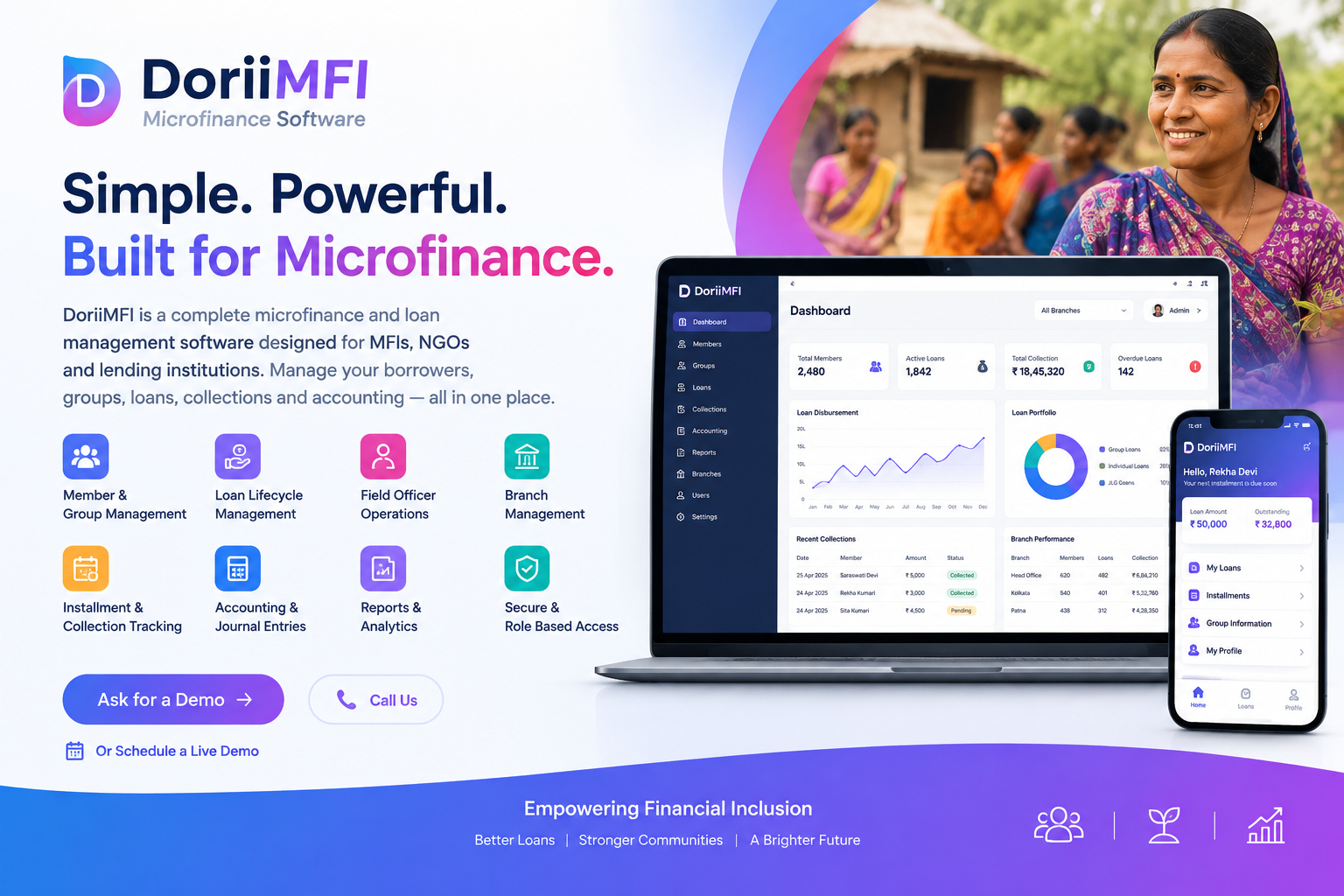
DoriiMFI by Dorii Software is designed to bring member management, groups, loans, installments, collections, accounting and reporting into one connected platform.
If you want to understand how a dedicated system could fit your organisation's working process, contact Dorii Software to discuss your requirements and arrange a demonstration.
Dorii Software — Microfinance and Loan Management Software.
Website: https://dorii.in/solutions/micro-finance-software
Call or WhatsApp: +91 97329 39123